
- Details
- Category: Learn
Is PMP Certification Worth It in 2026? A Honest, Data-Driven Answer
Let’s cut to the chase. In 2026, the Project Management Professional (PMP) certification from PMI will cost you:
- **Exam fee:** $405 (PMI member) / $575 (non-member)
- **Membership:** $139 (optional but recommended)
- **Prep course:** $300–1,500
- **Study time:** 60–120 hours
**Total investment: roughly $800–2,200 and two months of your life.**
The question isn’t whether PMP *used* to be valuable. The question is: **in a world of AI project tools, agile-at-scale, and hybrid work, does PMP still pay off in 2026?**
After analyzing salary surveys, job market trends, and PMI’s 2025 updates, here’s the short answer: **Yes, for the right person. No, for everyone else.**
---
## What Changed in 2026? (The New PMP Context)
Since 2021, PMI has updated the PMP exam content twice. The 2026 exam is roughly:
- **50% agile/hybrid** (up from ~20% a decade ago)
- **40% predictive (waterfall)**
- **10% business analysis & value delivery**
More importantly, PMI now tests **real-world scenario judgment** — not just memorizing ITTOs (Inputs, Tools, Techniques, Outputs).
So the 2026 PMP is **not your boss’s PMP**. It’s harder, more practical, and better aligned with how projects actually run today.
---
## The Case FOR PMP in 2026
### 1. The salary bump is still real
PMI’s 2025 *Salary Survey* (published late 2025) showed:
- Median salary for PMP holders in the US: **$125,000**
- Non-certified project managers: **$98,000**
- **~28% premium**
In IT, construction, healthcare, and defense, the gap is even wider.
### 2. AI won’t replace PMs – but it will replace PMs without PMP-level judgment
This is key. AI tools (Jira AI, MS Project Copilot, Asana Intelligence) can draft schedules, flag risks, and summarize status. But they can’t:
- Negotiate with a hostile stakeholder
- Choose the right governance model for a risky project
- Tailor agile ceremonies for a remote, cross-cultural team
PMP teaches **decision frameworks**, not tool clicks. That becomes *more* valuable as AI handles routine work.
### 3. Government & large enterprise still require it
In the US federal government (Section 852 of DoD instruction 5000.02) and most Fortune 500 PMOs, PMP is a **contractual requirement** for lead PM roles. In 2026, that hasn’t changed. Want to work at Lockheed Martin, Deloitte, Pfizer, or Siemens? HR filters for PMP.
### 4. Passing rate is dropping – which increases scarcity
Rumor from PMI training partners: the 2026 pass rate is now **~60–65%** (down from ~70% pre-2023). A harder cert means more differentiation.
---
## The Case AGAINST PMP in 2026
### 1. You work in pure product/startup environments
If you’re a product manager at a Series B SaaS startup, or a technical program manager at Meta/Google (which values its own internal certs), PMP is seen as **legacy credential**. They’d rather see Scrum.org PSM III or SAFe SPC.
### 2. You have <3 years of project experience
PMP requires 36 months leading projects within the past 8 years. Some people stretch that, but if you’re genuinely early-career, PMP won’t magically give you seniority. Get CAPM first or focus on agile certs.
### 3. Your industry doesn’t value it
| Industry | PMP Demand (2026) |
|----------|------------------|
| Construction, Energy, Defense | High (required) |
| Healthcare, Pharma, Insurance | Medium-high |
| IT services, Consulting | Medium |
| Tech product (FAANG) | Low |
| Creative agencies, Nonprofits | Very low |
Check 10 job descriptions you actually want. If none mention PMP, skip it.
### 4. The hidden cost: renewal
Every 3 years, you need **60 PDUs (professional development units)** – about 20 hours/year. That’s a recurring tax on your time. Let it lapse? You have to retake the exam.
---
## Who Should Get PMP in 2026? (The Decision Matrix)
✅ **Get PMP if:**
- You work (or want to work) in construction, government, defense, healthcare, financial services, or large-scale IT/ERP.
- Your employer reimburses exam + prep (many do).
- You’re stuck at a salary ceiling below $110k and need a credential to break through.
- You’re an international PM targeting US, EU, or Middle East roles (PMP has global recognition).
❌ **Skip PMP if:**
- You’re a product manager, startup founder, or technical lead in a fast-moving tech company.
- You have <3 years of experience.
- You’re already in a senior PM role (>$150k) without it – the ROI is lower.
- You hate formal processes and live in pure kanban/flow-based teams.
---
## The Verdict: Worth it? (Yes, with a but)
**In 2026, PMP is not a universal golden ticket. But it is the single most transferable, vendor-neutral project management credential for high-stakes, regulated, or large-scale environments.**
Think of it like a commercial driver’s license (CDL). You don’t need a CDL to drive a Prius. But if you want to drive a semi-trailer of a $50M ERP implementation? You’d better have it.
**Final advice before you decide:**
1. **Take a free PMP practice exam** (PMI has a sample test). If you score >60% cold, you’re ready. If <30%, you’ll need serious study.
2. **Ask for reimbursement** – 70% of employers will pay if you pass.
3. **Consider CAPM first** if you’re early-career.
---
## One Sentence for Your Resume or LinkedIn
> “PMP certified (2026) – expert in hybrid project governance, stakeholder negotiation, and risk-adjusted planning in AI-augmented environments.”
That’s the 2026 value. Not memorizing processes. Proving judgment.
---
**Ready to start?**
PMI’s 2026 exam reference list: *The PMBOK Guide – 7th Edition* + *Agile Practice Guide*. Skip the outdated 6th edition.
*Did this help? Share it with a colleague debating PMP in 2026.*
- Details
- Category: Learn
A Guide to the Project Management Body of Knowledge (PMBOK® Guide) is PMI's flagship publication and is a fundamental resource for effective project management in any industry. It has been updated to reflect the latest good practices in project management.
Over the past few years, more and more stakeholders have asked us for content on agile — and more are using agile practices, which is confirmed by our Pulse of the Profession® research. That's why we included information on agile practices will be included alongside traditional approaches in the Sixth edition and partnered with Agile Alliance® to create the new Agile Practice Guide*.
The PMBOK® Guide – Sixth Edition and Agile Practice Guide were created to complement each other. Together these two publications are a powerful tool that enable the right approach for the right project.
When you order the PMBOK® Guide – Sixth Edition (in English) you will receive a complimentary copy of the Agile Practice Guide.
This dynamic duo presents solutions for project delivery professionals working in the entire spectrum of approaches — from predictive (or waterfall) to cutting edge agile methodologies.
Translations
The PMBOK® Guide – Sixth Edition is available for download in English and 11 additional languages (Arabic, Chinese [simplified], French, German, Hindi, Italian, Japanese, Korean, Portuguese Brazilian, Russian and Spanish). Print versions will be available in October.
The translated PMBOK® Guide – Sixth Edition/Agile Practice Guide will be available at a later date (TBD).
By Project Managers, For Project Managers
The PMBOK® Guide is developed by active practitioners and subject matter experts, then reviewed by the project management community before it is released, to assure it always reflects the current state of the profession.
Why is the PMBOK® Guide changing?
- Project Management has evolved significantly since we published the PMBOK® Guide – Fifth Edition in 2013.
- Part 2 of the PMBOK® Guide is accredited by the American National Standards Institute (ANSI) and must be updated every four to five years.
- PMI continually learns more about what drives successful project outcomes through our research… and we want to share those drivers with the project management community.
What’s New in the PMBOK® Guide – Sixth Edition?
The PMBOK® Guide – Sixth Edition includes information on how to implement its approaches in agile environments — a first for PMI.
Other additions include:
- Trends and emerging practices
- Tailoring considerations
- A greater emphasis on Strategic and Business Knowledge
- A new section on the role of the project manager
- Details
- Category: Learn
PMP is one of those credentials whose reputation precedes them. Nevertheless, here’s a few reasons you should consider getting a PMP Certification.
Reason #1: PMP is a globally acknowledged certification
Reason #2: A PMP credential leads to a steep hike in salary
Further, new research from the Project Management Institute, suggests that 71% of project managers saw an increase in compensation over the last 12 months.
PMPs earn a median salary of $110,000 a year.
Reason #3: A PMP Credential Greatly Expands Your Market Reach and Scope
Reason #4: PMPs Have Better Job Opportunities
Thus, a PMP Certification opens up better career avenues and provides professionals with greater job opportunities in the project management world.
Reason #5: PMPs Get The Most Challenging Projects
Besides, as the PMP Exam eligibility criteria include both education and experience for project managers, a PMP Certification validates one’s skills and experience leading and directing projects.
Reason #6: PMPs Have Enhanced Project Management Skills And Demonstrate Better Project Performance
Further, a professional needs to be aware of all nine knowledge areas of project management, including project scope management, integration management, human resource management, time management, cost management, quality management and procurement management, with in-depth knowledge in order to qualify for the PMP Exam.
This enhances their project management skills immensely, and allows the project manager to tackle all manner of projects with consummate ease.
Reason #7: Greater Visibility To Recruiters
Reason #8: Utility Across Industry
Reason #9: Planning Ahead
Once you consider the failure rate, you may decide that you need to take courses, which run between $1,500 and $2,000, and that does not include the cost of the exam.
Reason #10: PMPs Are Secure Even During Economic Downturns
Agree with our list? What were YOUR reasons for getting a PMP certification? Let us know in the comments section.
In between that, here is a sample video that takes you through introduction of PMP certification. Hope you find it beneficial.
- Details
- Category: Learn
1. W3Schools – “SQL Tutorial”
W3Schools claims to be the largest web developer site on the Internet. It provides various tutorials and references on web development languages such as HTML, CSS, JavaScript, PHP, SQL, and JQuery, covering most aspects of web programming.

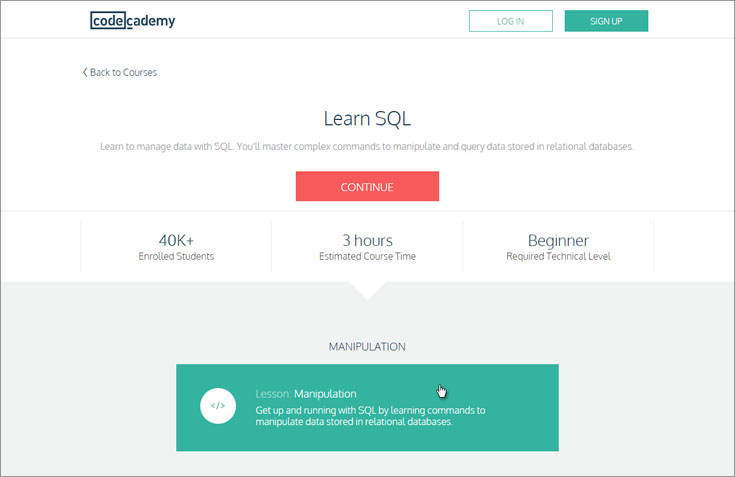
2. Codecademy – “Learn SQL”
Codecademy is an online platform that offers a wide range of free coding courses in programming languages like HTML, JavaScript, jQuery, PHP, Python, and Ruby. In addition to these courses, Codecademy’s students can learn how to manage data with SQL.
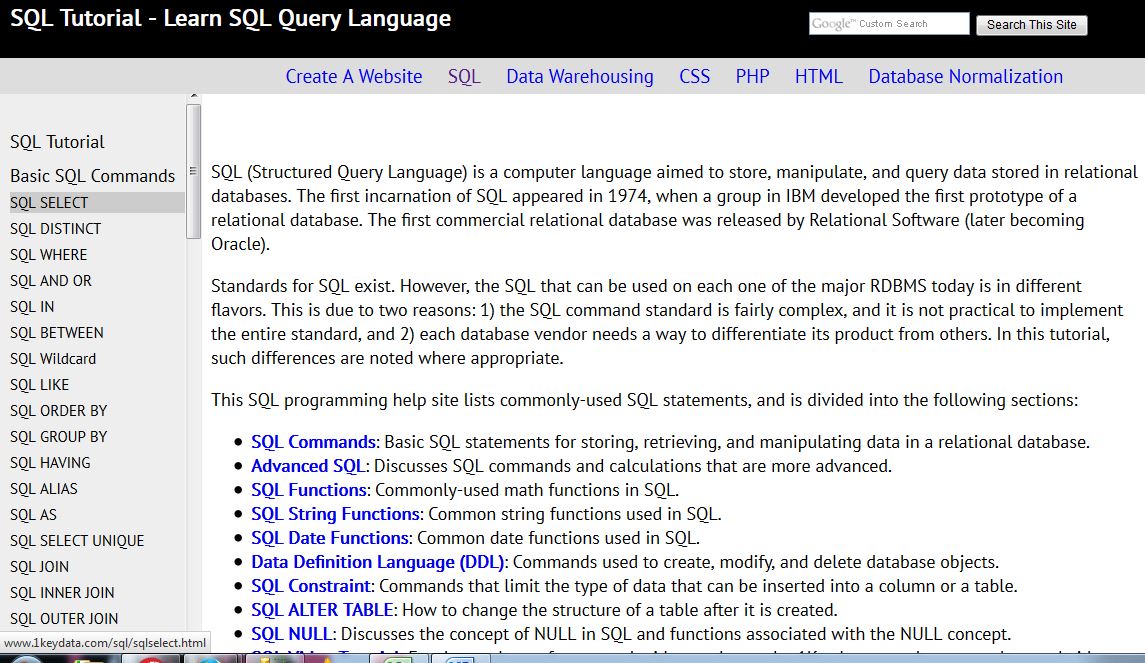
3-1keydata
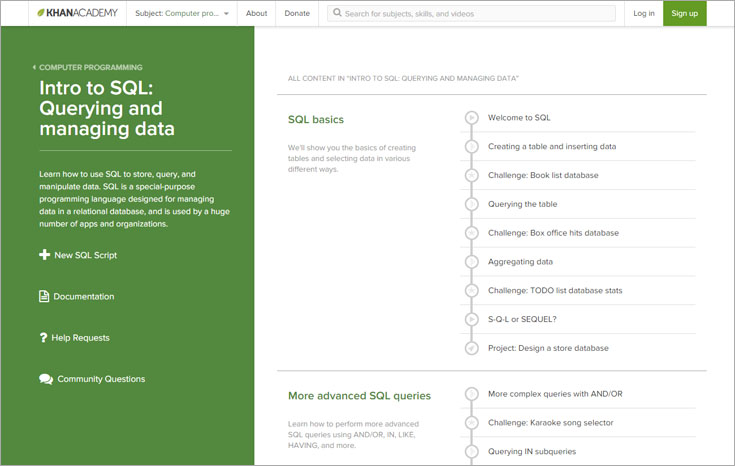
4. Khan Academy – “Intro to SQL”
Khan Academy provides its users with micro-lectures in the form of YouTube videos, lots of practice exercises, and a personalized learning dashboard. Combined, these tools empower learners to study at their own pace inside and outside of the classroom.
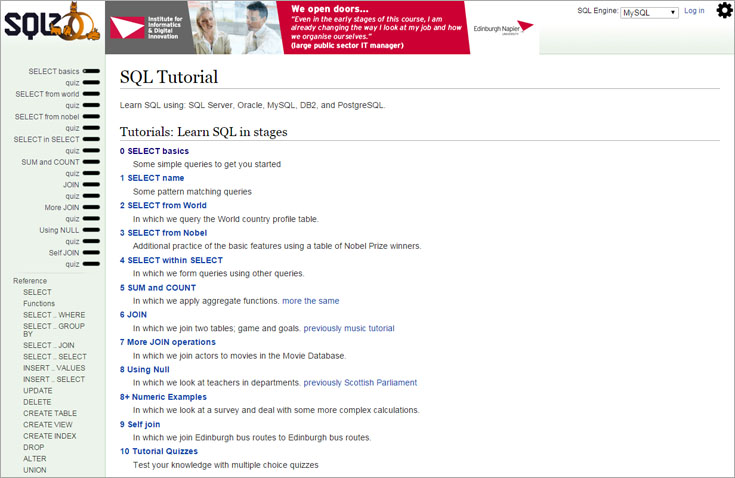
5. SQLZoo
SQLZoo is a nice free and interactive SQL tutorial developed and maintained by Edinburgh Napier University.
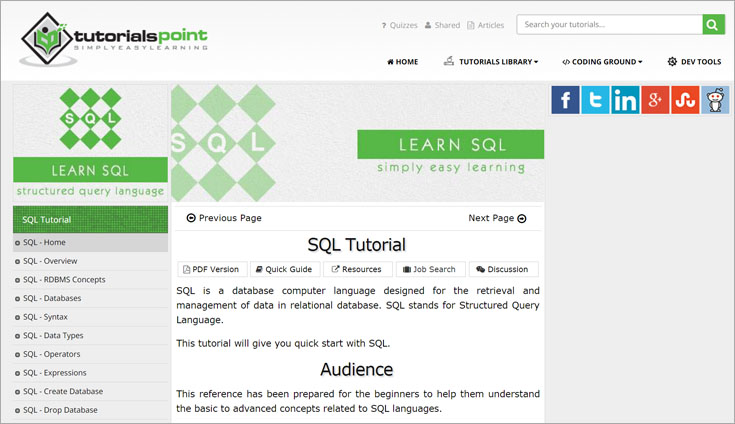
6. Tutorials Point – “Learn SQL”
Tutorials Point claims to be the web’s largest library of tutorials. Indeed, it offers dozens of online courses in computer engineering, information technology, programming languages, and management.
7. Udacity – “Intro to Relational Databases”
Udacity offers interactive online courses aimed at advancing academic and vocational skills. Although Udacity is profit-oriented, some courses are available for free.

8. SQL Problems and Solutions
SQL Problems and Solutions is an interactive textbook which lets you visualize tables and execute queries against a sample database. The tutorial explains the basic concepts and constructs of SQL and provides examples at various levels of expertise.

9. Tuts+ – “SQL for Beginners”
Tuts+ offers video courses and written tutorials that teach a wide range of creative and technical skills, including coding. Unlike video courses, all tutorials and articles are completely free. Based around specific projects, they include step-by-step written instructions and screenshots to help you practice and master your skills.

10. Essential SQL
Essential SQL, authored by Kris Wenzel (@sqlkris), is a great place to learn the fundamentals of SQL and database concepts. The course is based on Microsoft SQL Server, which is why the author provides newbie users with a guide on how to get started using this database engine.
- Details
- Category: Learn
Coming Soon
Contact us
This email address is being protected from spambots. You need JavaScript enabled to view it.